In an e-commerce market oversaturated with digital storefronts and algorithmic shifts, managing an affiliate program requires far more than handing out discount links. Succeeding in today’s landscape demands a strategic mix of full-funnel publisher recruitment, cross-channel coordination, and data privacy navigation.
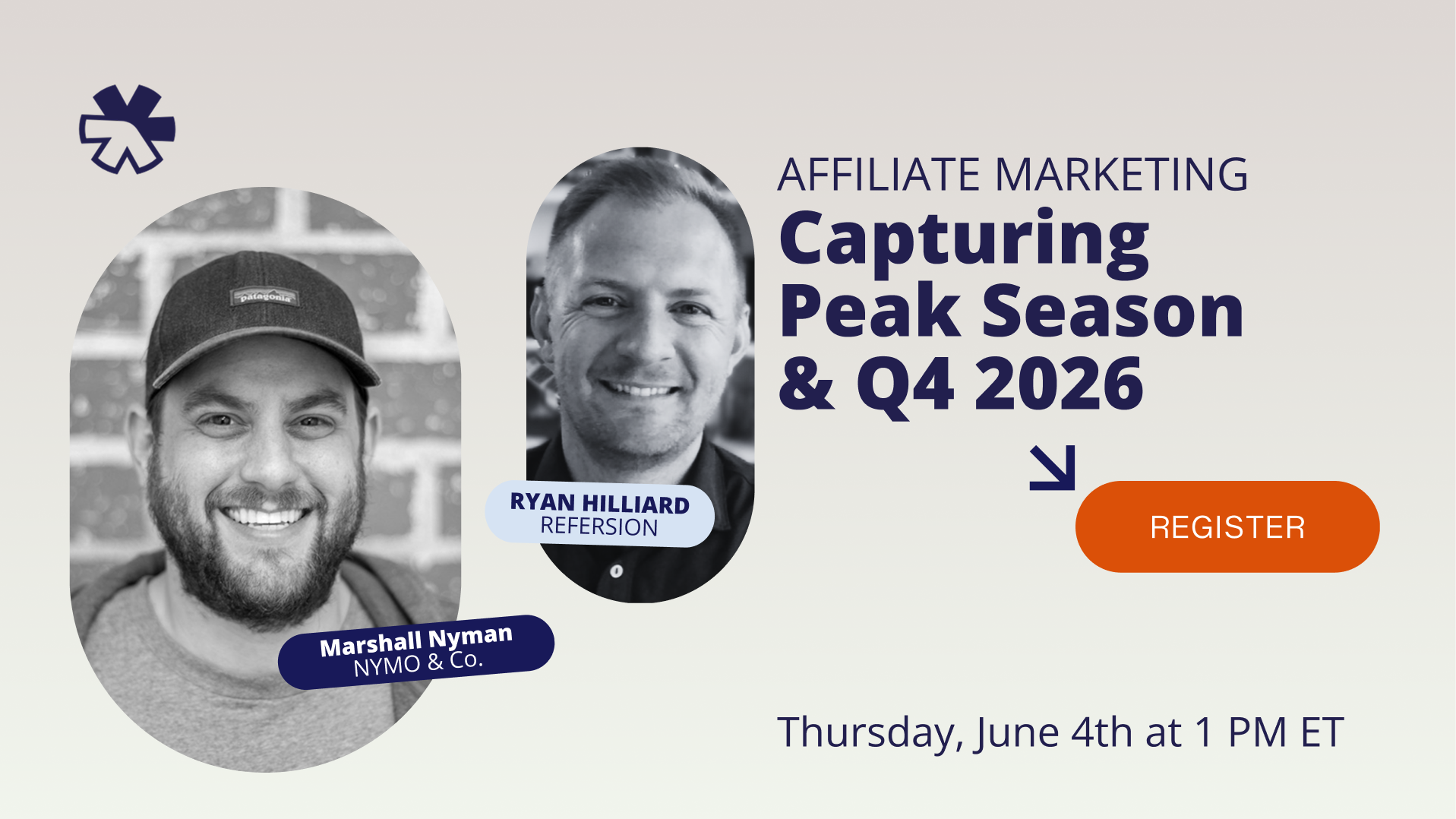
In a recent Refersion webinar, Ryan Hillyard, CEO of Refersion, sat down with Marshall Nyman, Founder and CEO of NYMO & Co. Celebrating nearly a decade in business, NYMO & Co. is a premier, boutique affiliate marketing agency that scales direct-to-consumer (DTC) brands from single-product startups into multi-SKU, high-revenue businesses.
Marshall shared his execution strategies for building a diverse partner mix, building an integrated corporate marketing engine, preparing for Q4 peak traffic, and navigating the future of AI-driven attribution.
1. The Full-Funnel Publisher Mix
Affiliate marketing has historically been pigeonholed as a purely bottom-of-the-funnel channel dominated by generic coupon lists. Marshall emphasizes that the modern affiliate landscape features diverse, highly specialized partners that span every layer of the buyer journey [07:49].
To build an expansive, sustainable program, map your recruitment strategy directly against the actual customer research path [08:23]:
                  THE EVOLVED AFFILIATE VALUE CHAIN

  ┌────────────────────────────────────────────────────────┐
  │ 1. TOP-FUNNEL CONTENT (Answering product research)     │
  └───────────────────────────┬────────────────────────────┘
                              ▼
  ┌────────────────────────────────────────────────────────┐
  │ 2. MID-FUNNEL APPRAISALS (Comparison reviews & specs)  │
  └───────────────────────────┬────────────────────────────┘
                              ▼
  ┌────────────────────────────────────────────────────────┐
  │ 3. BOTTOM-FUNNEL PERKS (Cashback / Card-linked offers) │
  └────────────────────────────────────────────────────────┘
- Content Publishers (Top-Funnel): These partners capture consumers at the inception of their buying intent. They educate audiences, answer niche industry questions, and position your product as the ultimate solution before a consumer even narrows down a specific brand choice [08:30].
- Review & Comparison Aggregators (Mid-Funnel): Once a consumer understands their core needs, they seek validation [08:40]. Comparison sites and tech reviewers help pit your products side-by-side with competitors, building credibility.
- Loyalty & Financial FinTechs (Bottom-Funnel): Card-linked offers, programmatic cashback browsers, and traditional high-affinity rewards programs capture the final transaction, driving completion at checkout [08:05].
2. Balancing Last-Click Metrics against Top-Funnel Risk
A fatal mistake new brands make when initiating partnerships is expecting top-funnel content creators to work under a highly restrictive, last-click commission model [16:34].
If your program metrics are configured to award 100% of the commission strictly to the last touchpoint (which is inevitably claimed by a browser coupon extension), your top-funnel content editors will lose tracking data and abandon your brand [16:34].
Protecting the Share of Voice
Content publishers do not operate on a simple “spray and pray” paid media budget; they are carefully optimizing their own share of voice [12:53], [14:38]. They track historic category performance data and view partnerships through a risk management lens [13:24], [14:51].
To win placement on high-authority sites, you must structure protective rules [16:56]:
- Custom Commission Tiering: Allocate separate, higher baseline commission rates specifically for content editors to insulate them from transactional bottom-funnel tracking leaks [16:56].
- Selective Flat-Fee Hybrid Models: If a media publisher creates an incredible, high-authority review that drives heavy organic traffic but minimal direct clicks, step up and reward them with an upfront flat-fee placement [19:53]. Compensating creators for past success builds trust, ensuring they continuously feature your brand in future editorial updates [20:27].
3. Ending the Siloed Marketing War
As e-commerce landscapes grow increasingly complex, the historic walls dividing corporate marketing budgets must be systematically dismantled [24:10]. Separate channels (Paid Social, SEO, PR, and Affiliate) frequently use isolated tracking dashboards that create internal friction—with multiple managers claiming credit for a single consumer checkout [22:18], [24:45].
The Coordinated Campaign Framework
The most elite DTC brands execute an integrated marketing approach orchestrated from the absolute top of the management stack down [23:05]:
                  THE INTEGRATED CO-LAUNCE LAYOUT

   ┌──────────────────────────────────────────────────────┐
   │              CENTRAL REVENUE DIRECTIVE               │
   └──────────┬──────────────┬──────────────┬─────────────┘
              ▼              ▼              ▼
       ┌──────────┐    ┌──────────┐   ┌──────────┐
       │   SEO    │    │    PR    │   │AFFILIATE │
       │ STRATEGY │    │ACTIVATION│   │ENGAGEMENT│
       └──────────┘    └──────────┘   └──────────┘
When rolling out a new product drop, synchronize your strategy across all fields [26:19]:
- Your SEO team targets specific search indexing trends.
- Your PR team coordinates editorial coverage.
- Your Affiliate team equips high-authority publishers with custom offers to support the exact same launch date [23:30].
Furthermore, marketing directors are actively shifting paid media ad dollars into affiliate budgets [23:59]. Investing affiliate capital directly into digital search positioning secures visibility within AI-driven consumer browsers—benefiting your SEO and performance initiatives simultaneously [24:24].
4. Seasonality Planning: Test Quietly, Scale Proudly
The absolute worst time for an online retailer to test an affiliate commission structure or deploy a new partner strategy is during peak seasonal spikes (like Q4 Holiday or Amazon Prime Day) [28:06]. Peak blocks are frantic, ad costs are highly volatile, and publishers are fully booked months in advance [27:42], [30:46].
The Q4 Preparation Runway
Marshall notes that your holiday performance is entirely decided before Q4 even begins [33:49]. If you wait until a week before Black Friday to message an editor about a gift guide placement, your brand will be ignored [34:48].
Follow this disciplined seasonal preparation runway:
- Q1 & Q2 (The Quiet Testing Zone): Use quieter quarters to test lookalike affiliate segments, experiment with tracking logic, and accurately gauge conversion velocity [28:24].
- Summer (The Pitch Phase): Summer is the time to finalize your Q4 holiday blueprints [29:42]. High-authority media outlets begin building and optimizing their winter holiday gift guides during July and August to ensure strong search engine indexing [34:32], [34:52].
- January (The Debrief Phase): Immediately after a peak quarter concludes, sit down with your agency team to debrief [32:33]. Document operational bottlenecks, track what content variations resonated, and embed those historical learnings directly into your next structural playbook [32:40], [32:57].
5. The Future: AI Scraping and LLM Network Attribution
As Large Language Models (LLMs) like OpenAI continue to reshape consumer discovery, the traditional link-click tracking system faces permanent structural disruption [20:45], [39:34]. Consumers increasingly ask AI engines for tailored purchase advice instead of clicking traditional outbound web links, causing data cookies to deprecate [19:27], [35:54].
Cross-Domain LLM Partnerships
To adapt, Marshall anticipates a major evolution where network platforms (like Refersion) forge deep, server-side data partnerships with AI firms [39:24].
Instead of an all-or-nothing last-click attribution model, advanced tracking algorithms can review customer research patterns inside an LLM [36:46]. The network can then intelligently distribute fractional, weighted commissions across the multiple publishers whose underlying content informed the AI’s recommendation engine [36:23].
The Unchangeable Factor: Human-to-Human Trust
Despite the explosion of automation tools, an affiliate program remains a relationship-driven channel [37:54]. Software can streamline back-end database research, but it cannot replace human connection [37:39], [38:41]. True growth is driven by getting out into the field, hosting interactive educational webinars, meeting partners face-to-face at industry events, and establishing unshakeable collaborative trust [38:01].
Final Thoughts
Winning in peak e-commerce seasons requires rigorous operational foresight. By moving past short-term testing habits, structuring fair full-funnel attribution models, and treating your marketing channels as a single cohesive engine, your brand can capture massive market share.
To review advanced network frameworks and listen to the complete masterclass discussion, watch the full webinar on YouTube: Affiliate Marketing: Capturing Peak Season & Q4 2026.