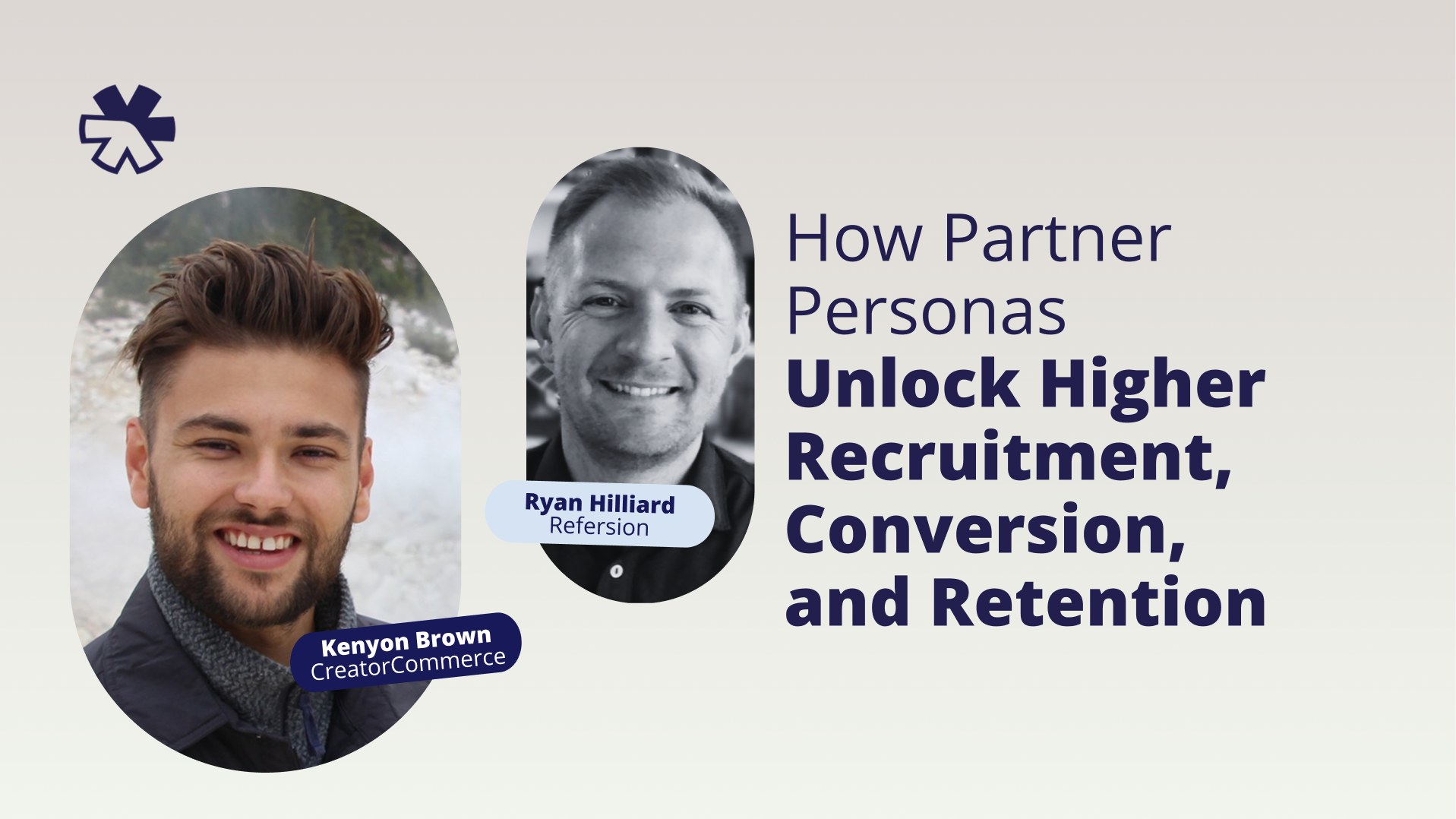
The common approach to managing an affiliate program is purely performance-based—sorting partners into “high performers” versus “low performers” [06:44]. However, treating affiliates as a monolith that only cares about a commission check is one of the biggest mistakes an e-commerce brand can make [04:47].
In a recent Refersion webinar, Ryan Hilliard, CEO of Refersion, sat down with Kenyon Brown, Co-Founder and CEO of Creator Commerce. Creator Commerce powers co-branded shopping experiences and personalized storefronts for major brands like Crocs, Cozy Earth, and Nudes .
Kenyon broke down the “Affiliate Trifecta”—a strategic framework rooted in partner personas that radically improves how brands recruit talent, optimize conversion rates, and retain advocates for the long haul.
1. Defining the “Partner Persona”
Just as your marketing team creates distinct customer personas to tailor ad messaging, your affiliate program must classify partners based on what uniquely motivates them [05:00].
A partner persona isn’t defined by sales volume; it is a classification of an affiliate’s audience, vocabulary, social risk, and underlying motives [05:27].
- The Reputation Stakeholders: If you are reaching out to professional practitioners (e.g., medical experts, estheticians, or salon owners), they are putting their hard-earned professional reputation on the line when they endorse a product [05:42], [12:39].
- The Trust Stakeholders: If you are partnering with traditional lifestyle content creators or micro-influencers, they are risking their audience’s social trust [12:48].
Because their motives differ, your outreach, vocabulary, and partnership offers must be tailored to their exact world [12:54].
2. The One-Two Punch for High-Converting Recruitment
When managing outbound recruitment (DMs and emails) and inbound registration pages, Kenyon advocates for a strategic one-two punch to win over new talent [10:23]:
                     THE RECRUITMENT ONE-TWO PUNCH

  ┌────────────────────────────────────────────────────────┐
  │ 1. EVAPORATE RISK (Prove legitimacy & social proof)    │
  └───────────────────────────┬────────────────────────────┘
                              ▼
  ┌────────────────────────────────────────────────────────┐
  │ 2. VISUALIZE THE FUTURE (Show formats & creative paths)│
  └────────────────────────────────────────────────────────┘
Step 1: Evaporate the Risk First
Before diving into standard partnership benefits, commission percentages, or product features, you must immediately eliminate any reputational hesitation a creator might have [11:01]. Prove your product isn’t “snake oil” [11:32]. Showcase five-star reviews, display medical or manufacturing research, and highlight the volume of other respected peers already in your program [11:39].
Step 2: Visualize the Future
Once you have derisked the association, help the partner envision the relationship [12:15]. Show them historical examples of how other creators successfully structure their content, detail the best-performing media formats, and outline what a typical product trial looks like [12:15].
3. The Activation Secret: Move Beyond the Form
A partner who fills out a registration form is merely recruited—they aren’t yet activated until they drive high-intent traffic [16:24].
If you are trying to breathe life into a stagnant program or launch a new initiative, do not underestimate the power of an introductory phone call [16:44]. Kenyon notes that even brands driving millions of dollars a month through automated affiliate programs still dedicate 20 to 30 meetings a month specifically to 1-on-1 onboarding calls [17:34].
Investing 60 minutes to personally share content ideas, gift product samples, and align visions with a high-potential creator can easily unlock $20,000 to $30,000 a month in predictable, long-term revenue [17:18], [17:54].
4. Eliminating the Website “Memory Leak”
A major failure point in modern creator campaigns occurs during the storefront transition. A creator tells a beautifully tailored, highly specific story to their audience on social media [19:56]. But when a viewer clicks the affiliate link, they are dumped onto a generic, hardcoded brand homepage where that specific narrative instantly vanishes [20:12].
Personalizing the Storefront Experience
To fix this “memory leak,” your landing pages must adapt dynamically to match the context of the entering traffic [21:23]. For instance, a fertility and supplement brand called Bredennbe runs diverse partnerships spanning influencers, customer advocates, and hospital groups [29:25]. Instead of using a static page, they alter the merchandising and logo branding on the landing page to seamlessly mirror the specific partner group that referred the user [29:33].
┌────────────────────────────────────────────────────────────┐
│              THE LANDING PAGE OPTIMIZATION LIFT            │
├────────────────────────────────────────────────────────────┤
│ 30% to 50% AVERAGE CONVERSION LIFT                         │
│ • Maintain creator name, image, and likeness on-page       │
│ • Lock in continuous partner continuity                    │
├────────────────────────────────────────────────────────────┤
│ UP TO 100% (+) SCENARIO LIFT                               │
│ • Display clear, auto-applied discount pricing upfront     │
│ • Eliminate "mental math" pricing sticker shock            │
│ • Let creators curate product order & bundle selections    │
└────────────────────────────────────────────────────────────┘
By passing creative control to your partners—allowing them to curate their favorite collections, order products dynamically, and construct custom bundles [24:45], [26:03]—you eliminate the friction of an endless product hunt and drastically elevate Average Order Value (AOV) [25:12], [25:28].
5. Auditing Efficiencies and Tracking “True CAC”
Evaluating an affiliate program through a raw, immediate cost-per-acquisition (CAC) lens is deeply flawed. Unlike paid channels with straightforward, linear ad spend, affiliate marketing carries abstract inputs like time, physical inventory, and administrative energy [28:02], [29:01].
To discover which partner personas are truly potent, Kenyon recommends a two-pronged audit:
- Shopify CLTV Breakdown: Tag customers in Shopify based on the referring partner persona [27:32]. Run a Customer Lifetime Value (CLTV) report to see if customers sourced from practitioners carry higher retention and long-term value than those acquired via lifestyle influencers [27:46].
- Input vs. Output Mapping: Track what operational style yields the highest activation rate [30:18]. You may find that mass-shipping free product boxes yields a low response, whereas taking the time to conduct an educational onboarding call leads to an 80% content sharing rate [28:45].
6. The Flywheel: Cultivating Content into Visual Case Studies
If you are managing a smaller program and struggling to recruit premium affiliates due to a lack of data, stop spreading your resources thin across hundreds of cold leads [36:55]. Focus entirely on making your first single creator successful. [37:54]
Turn that initial success story into a highly visual case study [34:21]. Showcase their co-branded landing page, highlight the content they created, and feature them prominently in a targeted email drip series to your dormant affiliates [34:36], [35:44]. Proving that success is entirely achievable by showcasing active peers is the fastest way to build institutional confidence and get the affiliate ball rolling [36:41].
Navigating Case Study Etiquette (Audience Q&A)
During the closing Q&A, an audience member asked if explicit contract permission is required to reference partners as a case study [38:05]. Kenyon provided a helpful rule of thumb:
- Public Case Studies & Paid Ads: If a case study will live publicly on your site or power a paid advertising campaign, always get a written thumbs-up from the creator to protect the relationship [38:34], [39:54].
- Private Outbound Communications: For private, 1-on-1 sales emails or Google Meet pitches to prospective affiliates, it is entirely fair game to reference historical facts [38:51], [40:05]. Feel free to name-drop active creators, point to their live social channels, and outline their broad conversion success to prove your concept works [39:22].
Final Thoughts
Affiliate marketing has matured far beyond generic discount codes. By taking care of inbound creator traffic with personalized storefronts and speaking directly to the unique professional or creative motivations of your partner personas, you can scale a high-converting, deeply loyal channel.
To listen to the complete masterclass and see how co-branded storefronts operate, check out the full session on YouTube: The Affiliate Trifecta: Recruit Better, Convert More, Keep Them Longer.