When your business model revolves around rapid, low-cost impulse buys, traditional influencer marketing is relatively straightforward. You set a discount code, throw up some meta ads, and track direct sales.
But what happens when you sell high-ticket items, niche B2B services, or products that consumers only purchase once every few years?
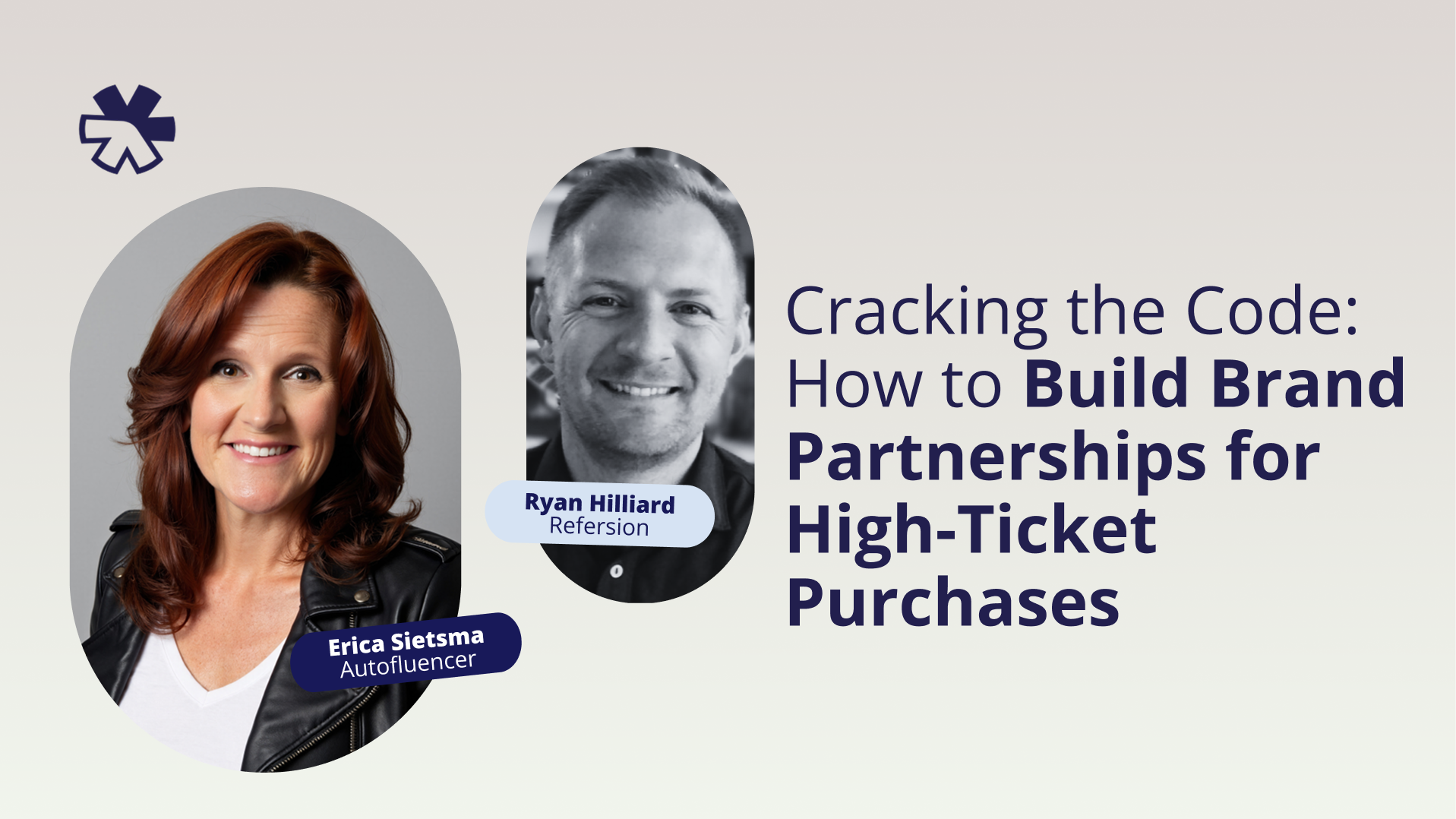
In a recent Refersion webinar, Ryan Hilliard, CEO of Refersion, sat down with Erica Sietsma, Co-Founder of Autofluencer. Autofluencer is a specialized platform that helps brands, agencies, and creators in motorsports, performance automotive, and outdoor recreation manage and quantify their partnerships [03:52].
Erica dropped invaluable strategic insights on navigating the intense complexity of non-impulse buying cycles. Whether you sell performance car parts, luxury jewelry, or enterprise software, here is your playbook for building influencer partnerships that drive real business value.
1. The High-Funnel Narrative: Beyond Immediate Attribution
In fields like motorsports and enthusiast automotive, purchases are governed by a complex set of parameters—compatibility, year/make/model constraints, and heavy financial consideration [14:12].
Because consumers rarely drop thousands of dollars on an impulse, raw downstream affiliate links tell only a small fraction of the story. To win in this space, you must focus heavily on the top of the funnel and understand Earned Media Value (EMV) [04:42].
Quantifying Your Social Real Estate
Autofluencer standardizes how high-funnel brand awareness is measured by looking at two primary social signals [05:16]:
- Visibility Metrics: Dividing raw views by 1,000 and multiplying them by a calculated Cost Per Mille (CPM) baseline [05:35].
- Engagement Metrics: Taking likes, comments, and shares, and multiplying them by an industry-standard cost per engagement [05:53].
Combining these numbers yields your EMV—the exact dollar amount a brand saved by having a passionate creator dynamically produce, tune, race, or build a vehicle using your product rather than paying for an expensive, studio-produced commercial advertisement [06:06].
2. Ditching the “Impulse Buy” Mindset
Once an item crosses a specific mental price threshold (often around $80–$100), the consumer’s behavior fundamentally shifts from “buy now” to “research and deliberate” [15:38].
  ┌────────────────────────────────────────────────────────┐
  │                 THE PRICE THRESHOLD SHIFT              │
  ├────────────────────────────────────────────────────────┤
  │ LOW-TICKET IMPULSE BUY                                 │
  │ • Quick dopamine trigger                               │
  │ • Immediate checkout                                   │
  │ • Simple affiliate codes dominate                      │
  ├────────────────────────────────────────────────────────┤
  │ HIGH-TICKET CONSIDERED PURCHASE                        │
  │ • Friction: "Let me measure/think about it"            │
  │ • Cross-device desktop research                        │
  │ • Long-term brand trust required                       │
  └────────────────────────────────────────────────────────┘
Why Commission Alone Fails
If you sell an $8,000 product that is highly restrictive, offering a flat 5% or 10% commission sounds great on paper ($400–$800) [18:22]. However, high-tier creators won’t invest hours building highly technical content on speculation alone [18:36]. They know their niche audience will create a “slush fund” and take months to buy [18:50].
The Hybrid Solution: Protection and Perks
Instead of forcing a purely transactional commission model, use tools like Refersion to offer custom solutions [20:00]. Many top-tier enthusiast builders don’t actually care about a small commission payout [19:38]. They prefer a hefty, exclusive product discount or 10% off promo codes to secure high-performance parts for their vehicles, providing clear tracking via links while respecting what the creator actually wants [19:53].
3. Trust by Association: The OG Influencers
Erica points out a beautiful historical parallel: Motorsports racers are the original influencers. [08:23] Decades before Instagram existed, drivers slapped brand stickers on their racecars, and enthusiasts bought those parts because they trusted that the product helped the driver win [08:38].
When your item is expensive or carries high failure risks, consumers will never buy from a generic ad. They rely entirely on trust by association [20:39].
“In our world, nobody is going to put something on their vehicle that they do not trust and believe in… brand trust is hard to quantify, but it completely eases your conversion rate.” — Erica Sietsma [21:05], [25:07], [29:50]
4. How to Structure Testing Without a Massive Budget
If you want to spin up or refine a high-ticket partnership campaign, Erica advises brands to stay far away from the deep end of the pool—don’t start by hiring an expensive talent agency or swinging for a $20,000 one-off activation [40:08], [41:56].
Instead, follow this highly cost-effective, incremental testing process:
Step 1: Mine Your Existing Customer Base
Go through your social media tags and historical purchase data [35:43]. Look for micro-influencers or everyday customers who paid full price for your product, love it, and have organically posted about it [35:51]. Because they are already raving fans, reaching out to offer a product discount or a comp on their next accessory is an easy, highly authentic win-win [36:21].
Step 2: Ditch the Script
Real humans buy from real humans [37:34]. Do not try to force a rigid script on your creators [37:02]. Let them showcase your item organically through their lifestyle—whether that means taking a performance part to the dyno to map true performance changes or reviewing it in the field [31:47].
Step 3: Benchmark and Normalize Engagement
Track the engagement rates across your trial creators relative to their following sizes [38:44]. Observe whose content visually resonates with your identity [38:57]. Once you identify your “ride or dies,” transition them into long-term partners [26:40].
5. Cultivating Community vs. Transactional Flops
The ultimate death sentence for a high-ticket program is a series of single, transactional posts. Erica shares a stark critique of brands that pour massive budgets into one-off influencer blasts:
If a consumer see a creator push a product aggressively once and then never mention it or show it in their daily life again, the audience instantly recognizes it as a paid, unauthentic ad [40:51].
Build For the Long Haul
Take inspiration from elite industry standard-bearers like QA1 (suspension and performance manufacturing) [45:10]:
- Human-Centric Scale: They started small by taking chances on everyday enthusiasts, sending out discounted or selectively comped products [45:28].
- Direct Access: Their affiliate manager handles events and builds deep, long-term friendships with their creator pool—they all have her personal cell phone number [45:28], [45:54].
- The Loyalty Payoff: As those micro-builders and racers organically blew up and grew massive followings over the years, their loyalty remained fiercely tied to QA1, cementing the brand as an unshakeable leader in the category [46:00].
Final Thoughts
When the purchase path takes weeks, months, or years, you cannot market like a commodity storefront. By leaning into earned media metrics, building a foundation of authentic user advocates, and prioritizing relationship longevity over quick transactional hits, you can build a brand that commands true, long-lasting trust.
To dive deeper into full-funnel tracking and see the complete discussion, watch the video recording on YouTube: How to Build Brand Partnerships for High-Ticket or Infrequent Purchases.